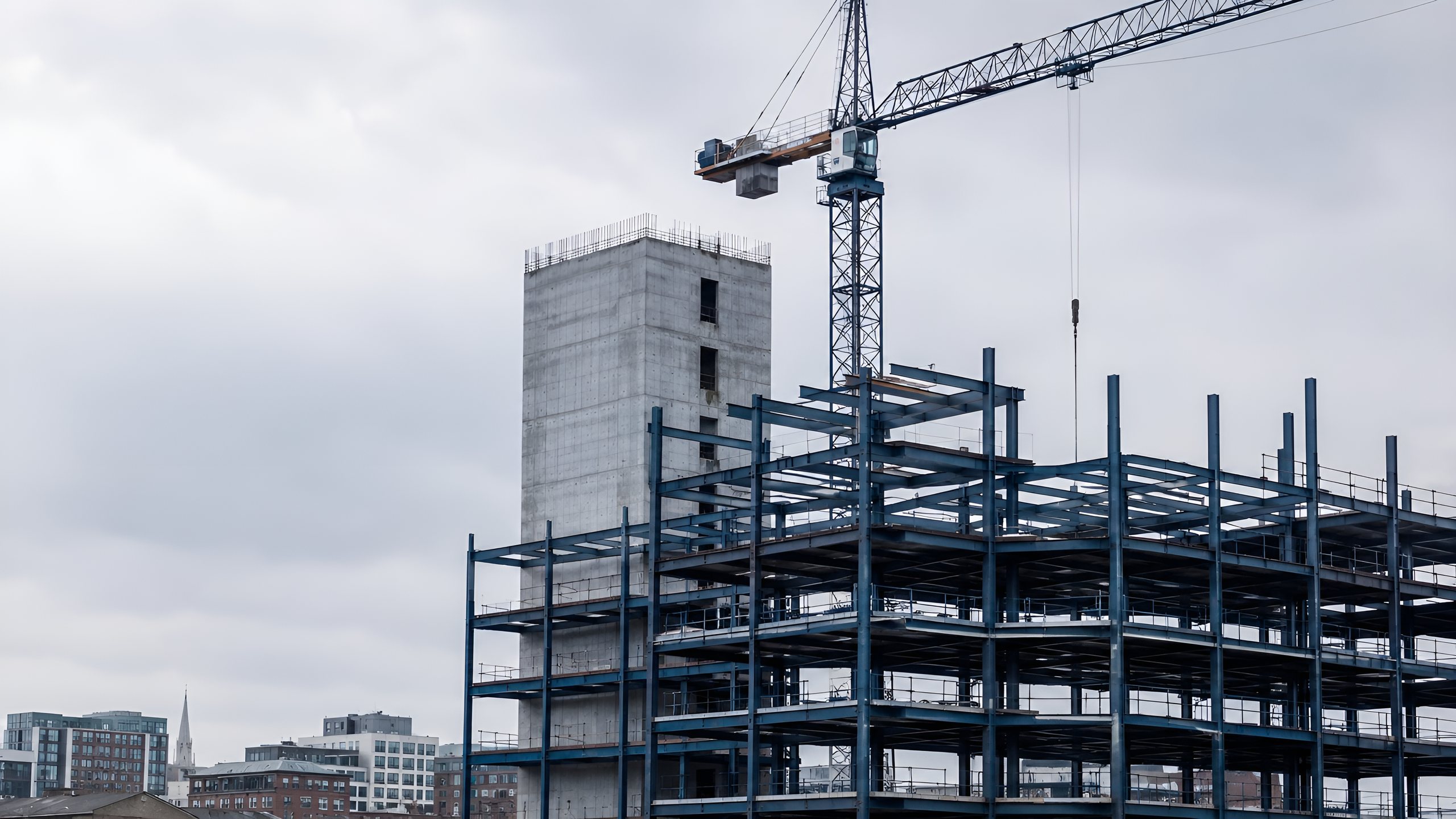
The estimator prices what is drawn. The problem is that a permanent works design shows the finished condition, and the finished condition is the only state in the whole programme that is stable without help.
Everything between the empty site and that drawing is a structure somebody has to design, and on most contracts it is not the person who produced the tender pack.
What a pre-construction structural review is, and what it is not
It is a structural engineer reading the tender information as a builder rather than as a designer, and answering one question: what does this design cost to build that the design does not say?
It is not a design check. A design check verifies that the permanent structure works. This asks whether it can be built in the sequence assumed, with the access available, to the tolerances specified, without temporary works nobody has priced.
Those are different exercises with different outputs. A design check produces a certificate. A review of this kind produces a list of things that will cost money later, each with an owner and a decision date, which is the only form in which the information is useful during a tender period.
What CDM 2015 already requires you to have before you price
More than most tender packs contain. The client "must provide pre-construction information as soon as is practicable to every designer and contractor appointed, or being considered for appointment, to the project" (CDM 2015, regulation 4). Note the last clause. The duty runs to tenderers, not just to the winner.
Pre-construction information is defined as information "in the client's possession or which is reasonably obtainable by or on behalf of the client, which is relevant to the construction work and is of an appropriate level of detail and proportionate to the risks involved" (CDM 2015, regulation 2). "Reasonably obtainable" is the phrase that gets skipped. A client who has never had a ground investigation done cannot claim the ground was unknowable.
The principal designer must "plan, manage and monitor the pre-construction phase", coordinate health and safety matters, assist the client with pre-construction information and provide it promptly to designers and contractors (CDM 2015, regulation 11), and must pass what they hold to the principal contractor for the construction phase plan, including "any information obtained from designers under regulation 9(3)(b)" (regulation 12).
The practical use of this at tender stage is leverage. A structural review that identifies what is missing from the pre-construction information gives you a specific, regulation backed request rather than a general complaint, and it does so while there is still time for the answer to change the price rather than the claim.
Where do the errors actually come from?
Mostly from the front end, and the industry has measured it. The Get It Right Initiative reports that "key international studies suggest that the measured direct costs of avoidable errors are in the order of 5% of project value", against typical industry profit margins of around 3 per cent, and that estimates of total cost including unmeasured and indirect effects run as high as 25 per cent of project cost (GIRI).
The more useful part is the list of root causes. GIRI's top ten are inadequate planning, late design changes, poorly communicated design information, poor quality culture, poorly coordinated design information, insufficient design consideration for construction, excessive commercial pressure, poor interface management and design, ineffective team communication, and inadequate supervisory skills.
Six of those ten are design and information problems, and every one of the six is visible in the tender pack before a single operative is on site. That is the argument for the review in one line: the errors are already present in the documents you are pricing from, and they are cheaper to find now than at the point of installation.
Value engineering that removes waste, and value engineering that removes capacity
The two look identical on a savings schedule. They are separated by whether anybody re-checked the thing that changed.
| Change | Removes waste when | Removes capacity when |
|---|---|---|
| Substituting a lighter section | Rechecked for deflection, vibration and connection capacity | Chosen on availability, with the connection design unchanged |
| Deleting a stiffener or a restraint | The element was restrained by something else that is definitely being built | It was providing the restraint the buckling check relied on |
| Changing the construction sequence | Every intermediate state is still stable and has been checked | The permanent works designer assumed the original order |
| Simplifying a connection | The simpler detail is verified for the same actions | It was simplified to fit, on site, because it would not physically go together |
| Reducing foundation depth | Ground investigation supports it and heave has been considered | Based on a trial pit somewhere else on the site |
Whoever makes the change is a designer under CDM 2015, whatever their job title, and must not accept the appointment unless they have "the skills, knowledge and experience" for it (CDM 2015, regulation 8). Our note on CDM 2015 and design responsibility covers where that liability attaches, and our guide to RC frame and steelwork connections covers the detail where most of these decisions actually get made.
The design basis question inside a long programme
A second generation of the Eurocodes is coming, and on a multi year programme the transition is a pre-construction question rather than a technical footnote.
The published timetable gives a date of availability of no later than 30 March 2026, a date of publication of 30 September 2027, and a date of withdrawal for conflicting first generation standards of 30 March 2028 (European Commission JRC). The coexistence window between publication and withdrawal is short.
For a contractor that raises three practical questions at tender stage. Which generation is the tender design prepared to, and does the specification say so. If the programme runs past the transition, does anything later in the works have to be designed to a different basis from what is already built. And if a design is revised during the works, does the revision inherit the original basis or acquire a new one. None of these is difficult. All of them are expensive to discover late, and all of them belong in a pre-construction review rather than in a technical query eighteen months in.
What the review actually produces
A register, not a report. The distinction matters because a report gets read once and a register gets worked through.
- Temporary works schedule. Every item the permanent design implies but does not show, with an indication of the likely design check category so the procurement lead time is visible.
- Information gaps. What is missing from the pre-construction information, framed against regulation 4 so the request has somewhere to go.
- Buildability items. Details that will not physically assemble in the order drawn, tolerance conflicts, and access constraints.
- Interface allocation. Who carries which design decision, agreed in writing before work starts rather than after a query comes off a live face.
- Risk items with decision dates. Each one owned, each one with the date after which it becomes a change rather than a decision.
PV Consulting provides feasibility studies, technical due diligence, value engineering and independent design review, with temporary works design and structural design and assessment where the review turns into work. Pre-construction work of this kind sits behind the aluminium lifting frame at Battersea Power Station and the runway rehabilitation study at Thessaloniki Airport, both shown in our case studies. You deal directly with the Chartered Engineer doing the work, which matters most during a tender period.
Sources
- Construction (Design and Management) Regulations 2015, regulation 2, Interpretation
- CDM 2015, regulation 4, Client duties in relation to managing projects
- CDM 2015, regulation 8, General duties
- CDM 2015, regulation 9, Duties of designers
- CDM 2015, regulation 11, Duties of a principal designer in the pre-construction phase
- CDM 2015, regulation 12, Construction phase plan and health and safety file
- Get It Right Initiative, Strategy for Change
- European Commission JRC, Second generation Eurocodes
- HSE, Latest annual work-related fatalities published, 1 July 2026