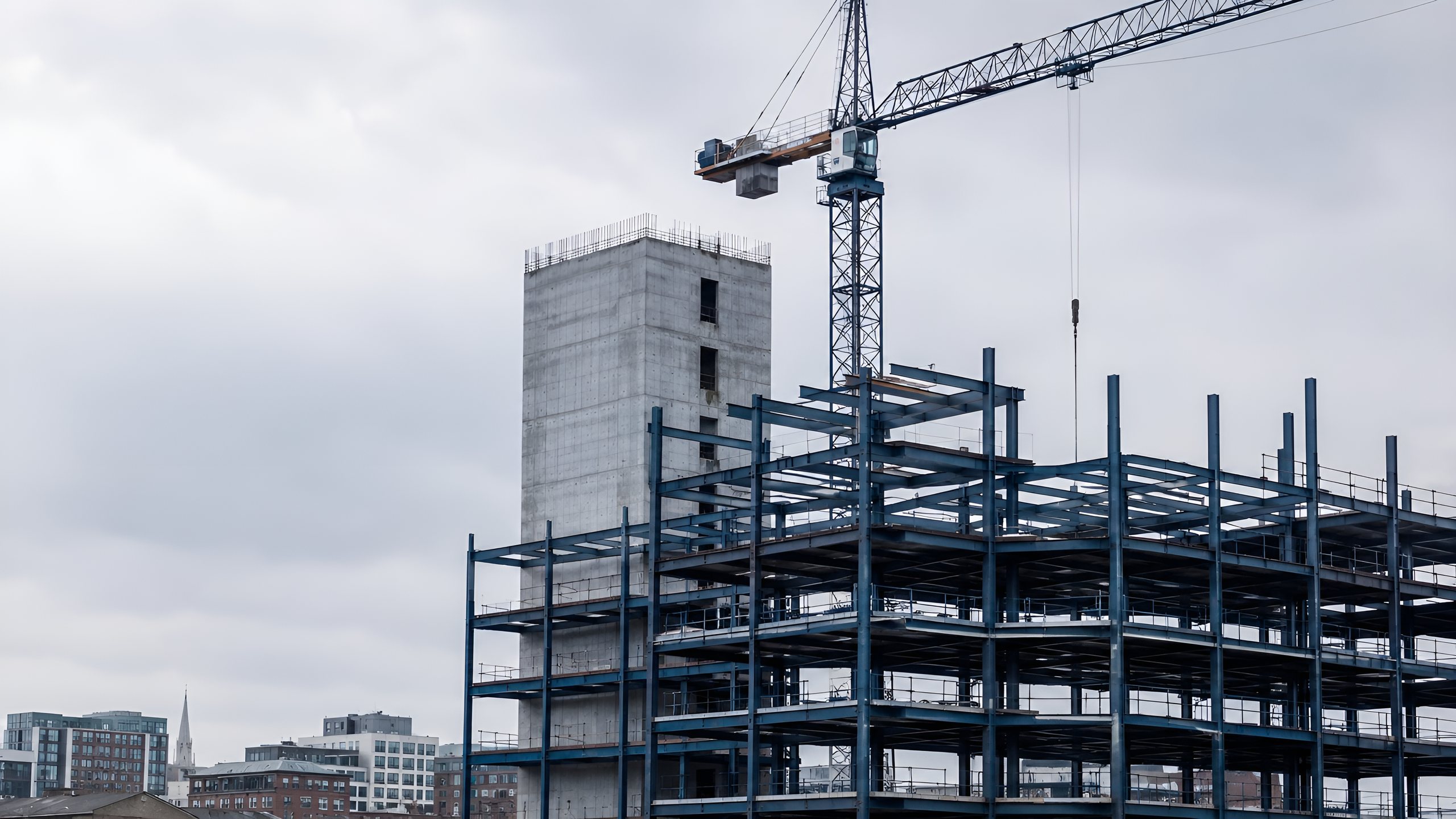
BSR's transparency data to 5 October 2026 and trade press reporting both describe the same pattern: new build Gateway 2 submissions nearly doubled in September as developers rushed to beat the Building Safety Levy before it took effect on 1 October, and the regulator's overall caseload has grown again even as approval rates sit at their best levels of the year.
For anyone building a feasibility study or a pre-construction programme for a higher-risk building right now, that is not background noise. It changes what a realistic Gateway 2 and Gateway 3 allowance looks like, and it is an argument for staged submissions and wider risk allowances rather than a single optimistic date on a Gantt chart.
What BSR's October data actually shows
The regulator's own figures for the 12-week rolling period to 5 October 2026 show that BSR made 378 building control decisions across all higher-risk building categories, with an overall national approval rate of 87%, equating to 20,471 residential units. For new build and conversion schemes specifically, the picture has kept improving: the approval rate has risen to 96% with a median approval time of 23 weeks for 11,822 units, and in London approvals stood at 97% with a 22-week median for 6,855 units.
The regulator tracks genuinely complex schemes separately, and this is the figure to watch if your project is not a straightforward repeat design. Nationally there are 30 live complex cases under active management with a median determination time of 34 weeks, rising to 35 weeks for the 19 complex proposals BSR is managing in London. That gap between a routine 22 to 23 week median and a 34 to 35 week complex median is the single most important number for anyone trying to put a defensible Gateway 2 date into a feasibility study.
Why Gateway 2 submissions nearly doubled in September
The surge itself is well documented. Construction Enquirer reports that September brought 64 new build submissions, up from 34 in August and 17 in July, ahead of the levy taking effect on 1 October, and that the overall Gateway 2 caseload grew by 34 during the month to 1,706 applications, including 186 new build and conversion cases. Schemes covering more than 40,000 homes now await decisions, with new build applications arriving twice as fast as BSR is determining them.
The logic behind the rush is straightforward once you read the levy regulations. The government's own assessment of impact confirms that the levy applies to any application for building control approval, or an initial notice, relating to the provision of 10 or more new dwellings, or 30 or more new bedspaces in purpose-built student accommodation, submitted on or after 1 October 2026, where the levy charging conditions are met, with exemptions for developments of fewer than 10 dwellings, affordable housing and a list of other uses. Anything submitted before that date, by definition, falls outside the charge. For a scheme of any size sitting near a decision point in September, getting the application in before 1 October was a commercial decision as much as a technical one, and the data shows a large number of developers made exactly that choice at the same time.
Gateway 3: a smaller caseload, but a genuine unknown
Gateway 2 gets most of the attention because it is the larger, better reported caseload, but Gateway 3 is where the programme risk is least understood. Construction Enquirer notes that Gateway 3 is emerging as another capacity challenge, with just nine applications determined over the latest 12 weeks, taking a median 20 weeks, and that no new build scheme that passed through Gateway 2 has yet reached that stage. BSR has said it expects new processes and additional resources to bring determination times down.
That last point matters for programming because the only Gateway 3 performance data available so far is drawn almost entirely from refurbishment work, not new build. BSR's July 2026 transparency release shows that of 277 Gateway 3 applications received to that point, 221 were for Category A/B refurbishments, and of the 124 already determined, the approval rate was 86% with a median determination time of 16 weeks. The more recent figure of a 20-week median across all Gateway 3 cases suggests times may already be drifting upward as volume grows, and there is still no like-for-like benchmark for a new build HRB going through Gateway 3 for the first time. Any programme that treats Gateway 3 as a fixed, short duration at the back end of a new build scheme is working from an assumption nobody can currently test.
What is actually driving the caseload, beyond the levy rush
The levy explains the spike in September, but it is not the only thing filling BSR's inbox. Construction Enquirer's reporting makes clear that internal refurbishment remains the biggest pressure point by volume, accounting for 1,109 live applications, with additional processing capacity due in the coming months. Existing building remediation, by contrast, is a genuine success story inside the same dataset: decisions have outpaced new applications, and just seven cases from 2024 remain, down from 42 at the start of the year.
BSR has responded on the resourcing side. The regulator has added 25 staff to its internal regulatory team over four months and plans further recruitment over the next six to 12 months, and it is expanding specialist teams, with integrated building inspector capacity forecast to rise from 22.4 full-time equivalent posts at the end of September to 34 in December. It has also activated contingency plans and introduced extra scrutiny before invalidating or rejecting applications, recognizing the potential impact on project viability, stating that it will only reject applications where there is no realistic prospect of approval within a reasonable timeframe. On engagement, BSR has said it will engage with applicants on an individual basis to discuss timelines for their projects, which is worth taking literally: if your programme depends on a specific decision date, ask.
Reform is coming, but not yet, and not for everything
It is tempting to assume the scope of Gateway 2 itself will shrink and take some pressure off. It is moving, but slowly and selectively. A July 2026 legal update from BCLP describes Gateway 2, the building control approval stage, as a hard stop: work cannot begin until BSR has approved the application. The government has confirmed that certain telecommunications work, including fibre optic cabling and some rooftop mast work, will not be subject to certain Gateway 2 requirements from 1 September 2026, and on the wider question of whether minor work within individual flats should need full Gateway 2 approval, the government is minded to proceed with an option that would exclude most such work, although a number of issues still require further consideration before a final decision. Any change arising from that review would need a statutory instrument before it took effect.
A separate consultation on emergency repairs closed on 3 September 2026 and explicitly excludes major cladding remediation and other large-scale, complex works, which would still require full Gateway 2 approval before starting. The practical message for anyone programming an HRB scheme today is that none of this reform changes your Gateway 2 or Gateway 3 route in the short term. Plan against the regime as it currently operates, not the regime as it may eventually be reshaped.
Translating the data into a realistic pre-construction programme
A feasibility study written against last year's guidance, or against a single average approval time, is not a programme, it is a hope. Three adjustments are worth making now.
- Use the median as a starting point, not a target. The national new build median sits at 23 weeks and London's at 22 weeks, but BSR itself notes that its median edged up from 22 to 23 weeks over the latest month as older cases were cleared, which shows the figure moves with caseload pressure, not just with application quality.
- Separate out anything that could be classed as complex early. The 34-week national median, and 35-week London median, for complex cases is close to half as long again as the standard route, and BSR manages these as a distinct population precisely because they behave differently.
- Treat Gateway 3 duration as provisional for new build. With no new build scheme yet through that gate, the 20-week overall median and the 16-week refurbishment-only figure from July are the only reference points available, and neither is a new build benchmark.
This is the kind of recalibration a pre-construction structural review is built to catch before it becomes a live programme problem, because it sits alongside the buildability and temporary works gaps that review already looks for.
Staged submissions and risk allowances: practical steps
A few concrete steps follow from the data above, and they apply whether you are pricing a tender or building an internal development programme.
- Build gateway periods as ranges, anchored to the latest published medians, and revisit them every time BSR issues new transparency data rather than fixing them once at outline stage.
- Flag complex elements of the design early so the scheme can be resourced and reviewed with the 34-week complex median in mind, rather than discovering the classification after submission.
- Get the application right first time. BSR's own contingency plans introduce additional scrutiny before rejection specifically because of the impact a rejection has on project viability, which cuts both ways: a well-prepared application is less likely to be caught by that scrutiny in the first place.
- Check levy liability and completion certificate implications early, particularly on schemes near the 10-dwelling or 30-bedspace thresholds, since the client must provide the information needed to calculate liability and a completion certificate can be withheld where the levy has not been paid.
- Keep temporary works and sequencing information ready ahead of submission. Queries on construction sequence or structural stability during the review period are avoidable delay, and our note on independent design checks and temporary works sets out what that information needs to contain.
- Pressure-test the whole programme against current data before you commit to it. This is exactly what our feasibility and pre-construction review service is for, and it is worth doing before a Gateway 2 date goes into a contract rather than after.
If you are programming an HRB scheme now and want the current Gateway 2 and Gateway 3 data built into your assumptions rather than retrofitted later, get in touch or call 07715 541143.