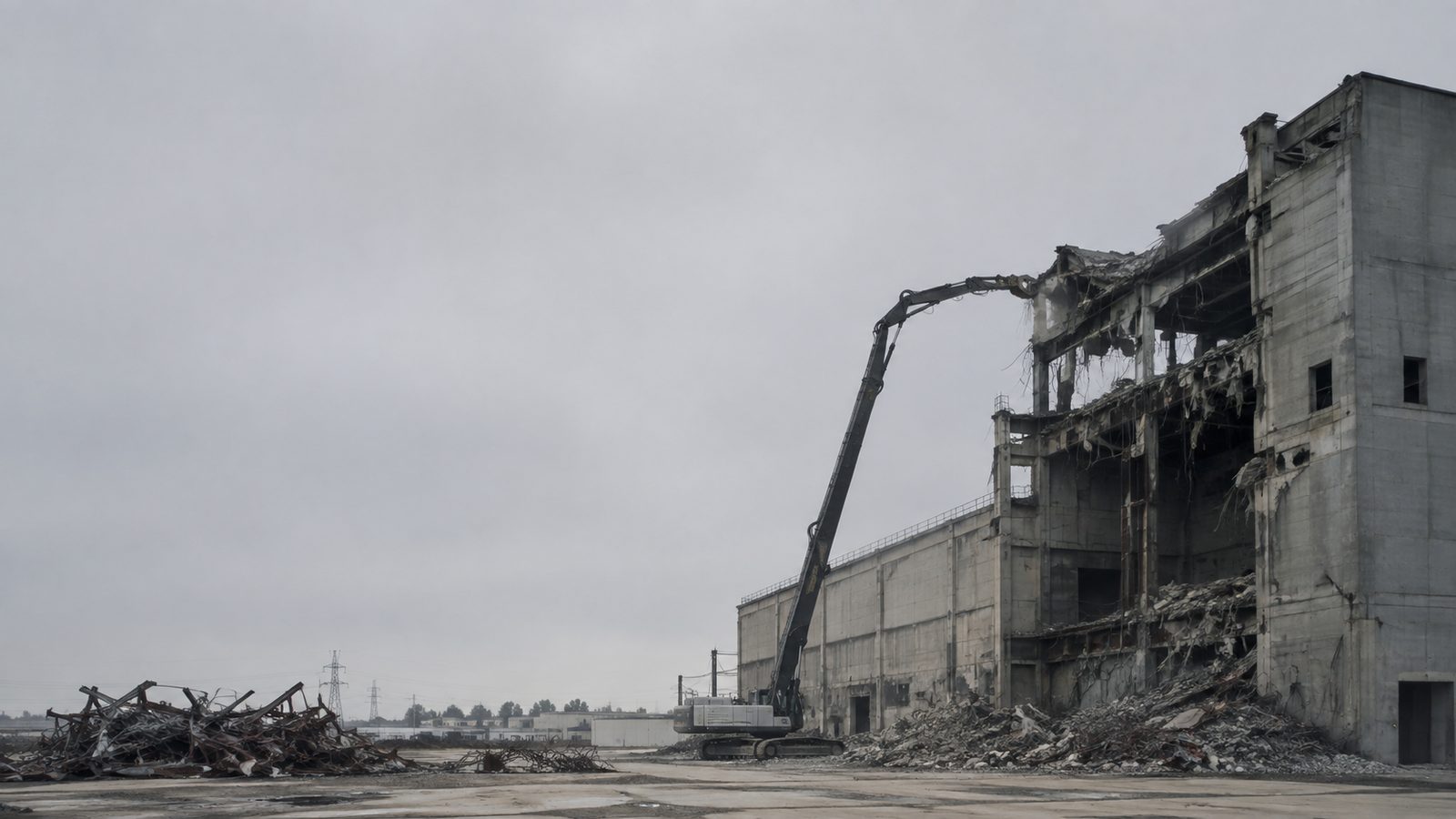
Deplanting is the removal of plant and equipment from a facility before demolition. In nuclear decommissioning both deplanting and partial demolition are engineered operations, because removing mass changes the structure's load path and stability at every stage of the sequence.
In ordinary demolition the structure is stable at the start and gone at the end. In nuclear decommissioning it has to be stable at every point in between, for years, while plant is stripped out of it and its height is progressively reduced.
That turns demolition into a temporary works problem rather than a plant and machinery problem. The engineering question is not how to take it down. It is what the structure is carrying, and how, at each intermediate state between full and final.
What is deplanting, and why is it an engineering activity?
Deplanting is the removal of process plant, mechanical and electrical equipment, pipework, vessels, cranes and internal fittings from a facility, ahead of or alongside structural demolition.
It looks like a dismantling exercise. Structurally it is a series of load changes.
Mass removal changes stability. Heavy plant frequently contributes to the stability of the structure around it, whether or not anybody designed it that way. Removing a vessel or a crane can unload a restraint, change a load path, or leave a frame carrying a lateral force it was never designed for.
Lifting imposes new loads. The lifting operation applies loads the structure never saw: point loads at padeye or lifting beam positions, out-of-plane forces during rigging, dynamic effects on release.
Access imposes loads. Scaffold, platforms, temporary craneage and cutting equipment all impose load on floors and frames whose remaining capacity has to be assessed against as-found condition, not original drawings.
Openings weaken diaphragms. Cutting an access route through a slab or wall to extract plant removes diaphragm action other elements were relying on.
Each of those is a temporary works design in its own right, checked against the state of the structure at that moment in the sequence rather than against the original design.
Why is partial demolition harder than full demolition?
Full demolition has one objective: bring it down safely. Partial demolition has two competing objectives: remove part of the structure, and leave the remainder safe, stable and durable, often for decades. That creates problems full demolition never has.
- The residual structure must be designed. What is left is a new structure with a new load path, new exposure conditions and a new design life, and it is rarely covered by the original drawings.
- The cut line is a design decision. Where you stop determines the stability of the remainder, the restraint conditions at the new top, and the load path down through the retained structure.
- Weathering and durability. A structure cut open and left standing is now exposed. Reinforcement cover, water ingress paths and the condition of newly exposed concrete all become design issues.
- Progressive collapse. Removing elements from a structure that has redistributed load over sixty years is not the same as removing them from the structure as designed. Load has found routes the original engineer did not intend.
- Reversibility. In a regulated environment, a sequence you cannot pause safely is a sequence you cannot use, because inspections and regulatory hold points will pause it.
What does BS 6187 require before any of it starts?
BS 6187, the code of practice for full and partial demolition, is the UK reference standard. Its most important requirement for engineering purposes is comprehensive knowledge of the structure and the site before the method is chosen: a structural survey establishing condition and stability, identification of hazardous materials, and location and isolation of services and adjacent structures.
In practice, the survey is where decommissioning programmes are won or lost. Original drawings for a 1960s power station are often incomplete, superseded, or describe a structure modified during decades of operation. The design that matters is the structure as it is, not the structure as drawn. Intrusive investigation, material testing and reinforcement location are engineering costs that look avoidable at tender and become unavoidable at execution.
What makes 1960s reactor buildings structurally demanding?
Magnox-era reactor buildings share characteristics that make them hard to reduce.
Massive reinforced concrete. Very heavy, heavily reinforced sections designed for shielding rather than structural efficiency. Cutting and sectioning is slow, imposes high loads on temporary support, and produces large arisings that have to be handled within the site's waste routes.
Changed behaviour once reduced. A building taken from around 54 metres to around 25 metres behaves fundamentally differently. Wind loading on a partially demolished form with open faces is not the loading the original structure saw.
Heavy overhead craneage. Cranes are structural. They apply load, they provide restraint, and their removal changes both. The Trawsfynydd programme involves removing around ten overhead cranes, two of which weigh more than a Boeing 747, which gives a sense of the loads involved.
Regulatory hold points. Work stops for inspection, sampling and approval. Every hold point is a state the structure must be safe to sit in, sometimes for weeks.
Records that do not match reality. Modifications, repairs and additions over decades, documented inconsistently.
What is happening at Trawsfynydd?
Trawsfynydd is a shut-down Magnox nuclear power station in Gwynedd, North Wales. The 392 MWe plant began operating in 1965 and was retired in 1991, with defueling completed by 1997. It has since been identified by the Nuclear Decommissioning Authority as the "lead and learn" site for accelerated Magnox decommissioning (World Nuclear News).
In October 2025, Nuclear Restoration Services, a subsidiary of the NDA, selected Costain to deliver the reactor building height reduction. The contract is worth approximately £70 million to Costain and the programme is expected to take around four years, employing more than 100 people at peak. It will lower the two 1960s reactor buildings from approximately 54 metres to 25 metres, recovering about 15,000 cubic metres of concrete and brickwork and removing about ten overhead cranes (Costain).
The stated purpose is twofold: reduce the visual impact of the structures on surrounding communities, and deliver the civils and remedial works that put the buildings into a safe and stable configuration for subsequent decommissioning. That second objective is the engineering one, and it is why this is partial demolition rather than demolition.
PV Consulting's role. PV Consulting acted as a supporting specialist supplier on the programme, providing temporary works design and independent design checks for demolition and deplanting operations, working to the standards required in a regulated nuclear environment. PV Consulting was not part of Costain's core delivery team.
Where do independent design checks fit in a regulated environment?
Nuclear clients rarely leave the design check category to engineering judgement. Category 3, requiring a checker organizationally independent of the designer, is commonly mandated by contract for anything with a meaningful consequence of failure.
The reason is specific to decommissioning. On an ordinary project a temporary works failure is a safety and programme event. On a nuclear licensed site it is also a regulatory event, with implications for the licence, the waste route and permission to continue. That drives a different check culture.
- The brief is checked as hard as the design. In decommissioning, the assumptions about as-found condition are the highest-risk part of the exercise.
- The sequence is part of the design. A check that verifies only the final condition has verified almost nothing.
- Traceability is mandatory. Every assumption, every source, every revision, recorded.
- Independence is real, not nominal. The checker's separation from the designer's commercial and programme pressure is the entire point.
This is the regime described in our guide to independent design checks and the BS 5975 categories, applied where the consequence of failure is highest.
Why is North Wales now two markets at once?
There is a commercial point here that main contractors have noticed and many engineering practices have not.
In November 2025 the UK Government confirmed an AI Growth Zone in North Wales. The site straddles the Menai Strait, with a base at Prosperity Parc on Anglesey and another at Trawsfynydd in Gwynedd. Government figures put 3,450 jobs as a direct result of the growth zone, taking the total announced for the area to nearly 6,500 once the Wylfa small modular reactor project is included. Across the programme as a whole, planning and energy reforms are estimated to unlock up to £100 billion of additional investment, enabling up to an additional 4GW of capacity (GOV.UK).
For engineering, that means one geography now generates two adjacent workloads: nuclear decommissioning on legacy sites, and heavy new build for data centre and energy infrastructure. The structural problems rhyme. Both involve very heavy plant, tight sequencing, restricted access, high consequence of failure and clients with formal assurance requirements.
The practices best placed for the second are frequently the ones already trusted on the first, because the assurance track record transfers. Our guide to the structural engineering behind data centre construction covers the new build side of that market.
For the wider policy and technology picture behind this shift, see the editorial Nuclear Energy: What Future for the World's Energy System?, written by PV Consulting's founder and first published in Italynews.it.
What should contractors look for in a specialist supplier?
For deplanting and partial demolition packages specifically:
- Sequence-based design experience, not just element design. Ask to see a staged stability assessment.
- Independence available on demand. A supplier who can provide a Category 3 check without a conflict, because they were not the designer.
- Comfort with incomplete information. The ability to design against as-found condition, with survey and testing scoped properly rather than assumed away.
- Chartered engineering judgement, directly accessible. On a live decommissioning face, the value is in reaching the engineer who did the work, in hours.
- Professional indemnity insurance appropriate to the consequence of failure.
- Traceable documentation that will stand up to client and regulator assurance review.
- Accurate description of previous roles. A supplier who overstates their involvement on a reference project is telling you how they will describe yours.
Frequently Asked Questions
Written by the founder of PV Consulting, a Chartered Engineer (CEng MICE, Institution of Civil Engineers) with over 30 years of experience in temporary works design, independent design checks and structural engineering across nuclear decommissioning, infrastructure and commercial construction. PV Consulting Ltd, company number 08294917, registered in England and Wales, professional indemnity insured.